I started noticing the same pattern in conversations with industrial companies.
Someone was looking for a supplier. They found the company’s website or directory profile, then called anyway to ask questions that should already have been answered: what the company makes, who it serves, what it can handle, and which standards it works under.
The information existed. It simply was not organized in a way an outsider could use without asking for help first.
That pattern has a name
We call it Commercial Information Infrastructure.
It is not just a polished website. Nor is it “digital presence” in the broad, generic sense.
It is the system that structures, connects, and maintains a company’s commercial information so its identity, capabilities, and evidence can be understood wherever the company is researched, evaluated, or required.
Why does it matter in 2026?
Because the research behind commercial decisions no longer happens in one place, and it does not necessarily begin with a sales call.
A potential customer may review the website, compare profiles, look for certifications, check industrial directories, or ask an AI system to explain what the company does. Each environment interprets the information it can access and may produce a different version when the sources do not match.
Every question the sales team has to answer repeatedly may also be a sign that valuable operational knowledge has not yet been turned into reusable commercial information.
In 2026, being online is not enough. Information has to be findable, consistent, and understandable to both people and systems.
It rests on three pillars
1.Website
This is the foundation. It holds the company’s identity, real capabilities, and supporting evidence. When the foundation is unclear, every other source inherits that lack of clarity.
2.Search and discovery
They make the foundation findable. Accurate information has limited value if a buyer cannot reach it while searching for a capability, service, certification, or supplier.
3.AI visibility
It determines what information tools such as ChatGPT, Claude, or Perplexity can use when they describe the company. When clear, verifiable information is unavailable, they still produce an answer from the sources they can find, even when those sources are incomplete or inconsistent.
A technically excellent website is still only one part
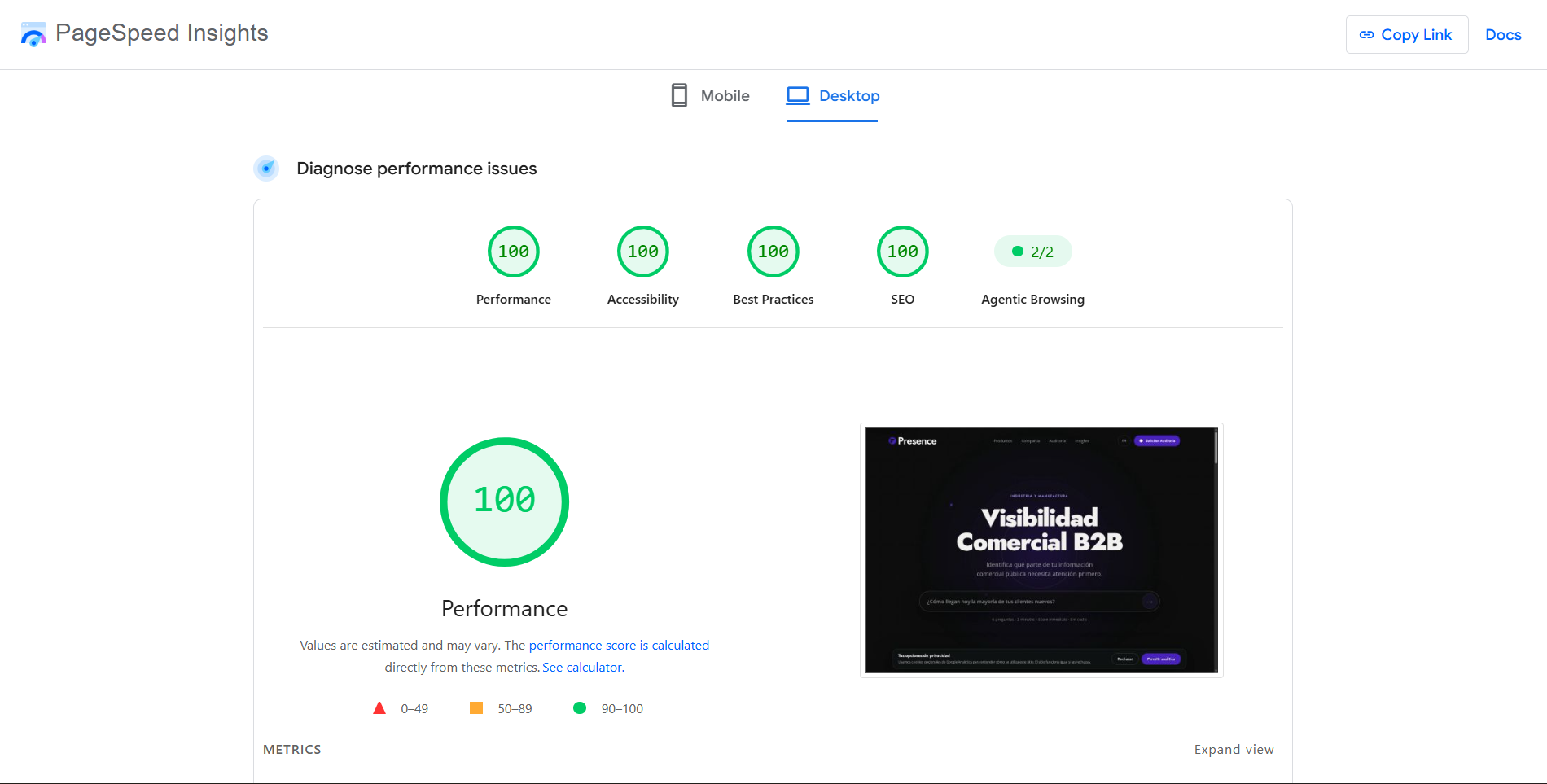
Technical performance matters. A fast, accessible, secure, and properly structured website creates a stronger foundation for user experience, indexing, and information access.
But a perfect score does not confirm that the company explains its capabilities accurately, that its profiles match, that its evidence is sufficient, or that AI systems can interpret the information correctly.
The problem starts when the pillars tell different stories
All three depend on the same underlying information.
When the website presents one capability, directory profiles retain an older version, and an AI system finds incomplete data, the company tells a different story depending on where someone looks.
The infrastructure prevents each channel from becoming an isolated asset. Its role is to establish a coherent commercial source of truth, distribute the information appropriately, and maintain it as the company changes.
Platonica Presence
Within Platonica, this practice has its own name: Platonica Presence.
The name reflects something we have come to understand more precisely: organizing and maintaining commercial information for industrial companies is a distinct practice, with its own discipline, standards, and responsibilities. It is also part of a broader Platonica universe built around one central idea: turning complexity into information people and systems can understand and use.
If your company depends on someone explaining what a customer, buyer, or system should already be able to see, that is exactly the problem Commercial Information Infrastructure is designed to solve.