
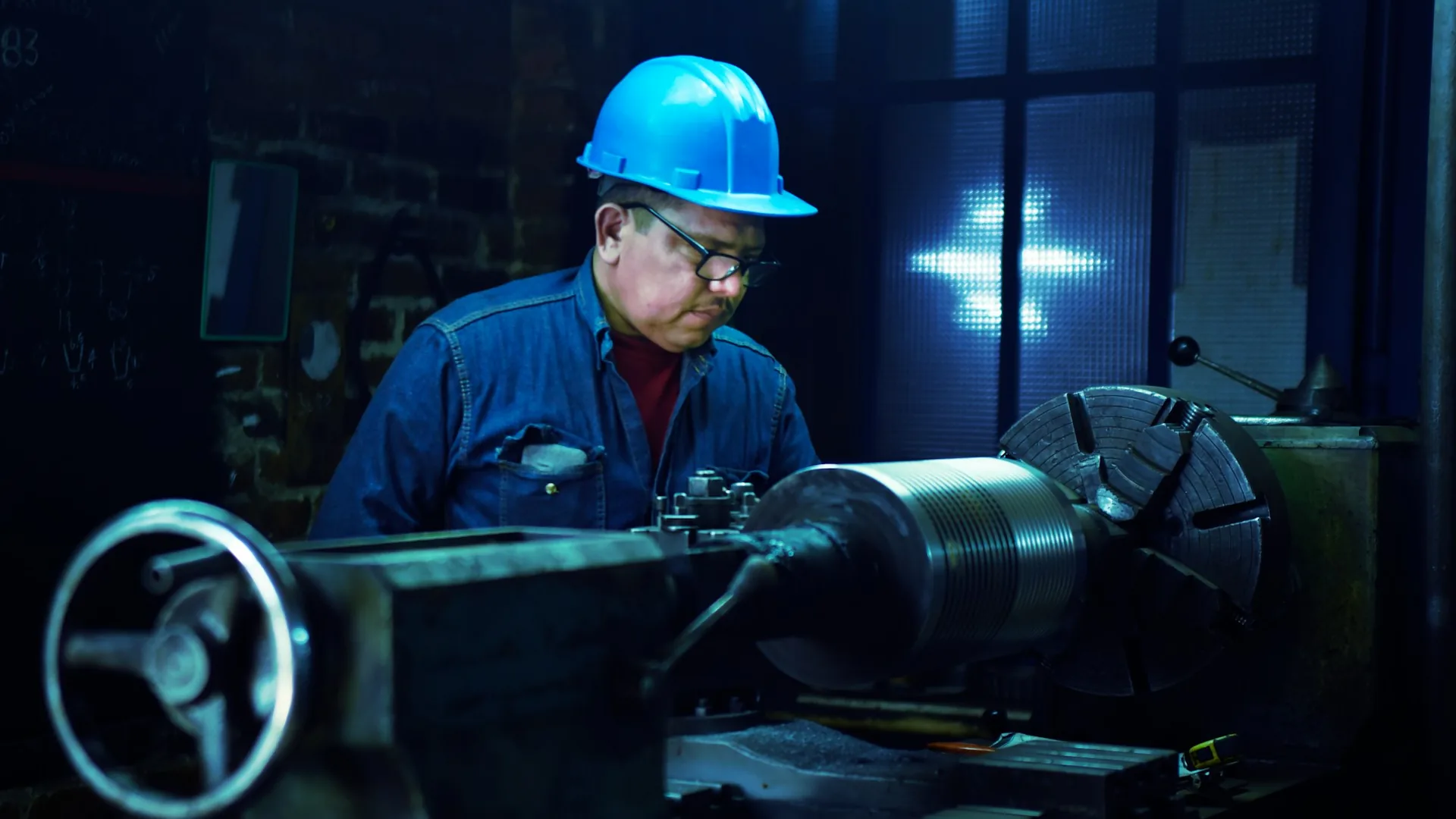
An industrial company can have twenty years of experience, specialized machinery, current certifications, important customers, and available capacity to execute a new project.
None of that guarantees that it will be considered when a buyer searches for a supplier.
The company knows its operation. It knows what it can manufacture, which tolerances it can hold, which industries it has served, which processes it controls, and which problems it can solve.
A buyer who has never worked with the company has no way to know that automatically.
Before a request for quotation, there is a less visible stage: discovering companies, eliminating alternatives, comparing possibilities, confirming requirements, and gathering enough information to decide which suppliers deserve a deeper conversation.
The distance between those two perspectives can be substantial.
The problem starts before the quote
For an SME, digitalization described only as technological modernization can hide a much more concrete motivation: selling more and reaching more customers.
In the OECD D4SME survey, increasing domestic sales was cited as an objective by 47% of surveyed digitalized SMEs and expanding the customer base by 41%. The sample covered seven countries and does not specifically represent Mexican manufacturing SMEs, so these figures provide context on business motivations rather than an estimate for Mexico’s manufacturing sector.
For an industrial B2B company, that need can take several forms: available production capacity, reduced dependence on a small number of customers, entry into another supply chain, exporting, participation in higher-value projects, or generating new requests for quotation.
The problem is that having the capacity to execute the work and entering consideration to execute it are different things.
The first belongs mainly to the operation. The second also depends on what the market can discover and verify about that operation.
B2B evaluation no longer happens in one place
The buyer also does not necessarily depend on a sales conversation to begin researching.
Gartner reported in May 2026 that B2B buyers consulted an average of seven information sources during a recent purchase. 45% used generative artificial intelligence, primarily to gather information about suppliers and products.
McKinsey found an even more distributed pattern in its 2026 Global B2B Pulse: buyers used an average of ten channels across their buying journey.
That does not mean every industrial purchase happens digitally. It also does not mean the salesperson has stopped mattering.
In fact, Gartner’s data shows an important combination: even as many buyers prefer to advance independently, 69% said they turn to sales representatives to validate AI-generated information.
What has changed is the order. Human interaction can remain decisive without necessarily being where the evaluation begins.
A capability can exist and still be commercially invisible
We can use commercially invisible capability to describe a specific condition:
The company has a real capability, but the information available outside the organization does not allow a buyer to discover, understand, or validate it with sufficient precision during a commercial evaluation.
It does not mean the company is incompetent. It does not mean its operation is weak. It does not even mean its website is bad.
It means there is a distance between the company that operates and the company that can be reconstructed from available information.
For example, a plant may have added a production line, a certification, greater volume capacity, a second location, a specialized process, experience in another industry, export capability, or new quality controls.
If that information remains only inside operations, private presentations, sales conversations, or outdated documents, the market may not be able to include it in its evaluation.
The capability exists. Its commercial representation has not yet caught up with the operation.
An evaluable capability must answer three questions
Not every piece of commercial information requires the same level of detail, but a capability intended to influence an outside evaluation needs to solve at least three problems.
1. Can it be found?
Before evaluating a capability, the buyer needs to reach it.
That can happen through search, the company website, an industrial directory, a referral, a sourcing platform, or a query made to an artificial intelligence system.
The surface can change. The requirement remains: the information has to be available where it can enter the discovery process.
2. Can it be understood?
Saying that a company provides “integrated solutions,” “world-class quality,” or “manufacturing excellence” says very little about a specific capability.
A buyer needs to understand what the company does, for whom, under which conditions, and where the limits of that capability are.
In industrial environments, seemingly simple words can hide important variables: materials, processes, dimensions, tolerances, volume, location, standards, lead times, markets served, or technical restrictions.
Commercial clarity does not mean simplifying the operation until it becomes generic. It means making it understandable without making it inaccurate.
3. Can it be validated?
A commercial claim and evidence are not the same thing.
A current certification, technical document, identifiable facility, representative project, properly documented capability, or external source can provide different levels of validation.
Industrial sourcing platforms such as Thomasnet allow buyers to filter suppliers by criteria such as certifications and company type, compare profiles, build lists, and request quotes. That workflow does not represent every industrial buying process, but it illustrates an evaluation that can begin before the RFQ.
Being found is only the beginning. Evaluation comes next.
Inconsistency is also part of the problem
A company can have correct information and still create uncertainty when each source tells a different version.
The website shows one location. A directory retains another. A presentation mentions a new capability. Google finds older information. An external source uses an outdated description. An AI system attempts to reconcile all of them.
Inconsistency does not always mean that any of those data points are deliberately false. Often it means the company changed faster than its information.
But the buyer does not see the internal process that produced the discrepancy. The buyer only sees the available sources.
McKinsey reported in 2026 that information inconsistency across teams and channels was among the leading triggers of supplier switching in B2B. In that context, keeping commercial information coherent is not only an editorial task. It also contributes to trust.
Website, Google, and AI are not three independent problems
As research becomes more distributed, it is tempting to manage each surface as a separate project.
The website as a design project. Google as a positioning project. Artificial intelligence as a new optimization project.
But all three ultimately depend on something that comes first: the quality of the commercial information available to represent the company.
The website can function as a primary source. Google needs to interpret, index, and relate that information to other sources. AI systems can combine information from the site, search engines, directories, publications, documents, and third parties to construct an answer.
That does not make AI a substitute for procurement, engineering, or sales. It does add another surface where the company can be interpreted when nobody from the company is present to explain what it meant.
The hardest opportunity to measure is the one that never arrived
There is a difference between losing a sale and never entering the competition.
When a company submits a proposal and loses, information exists: there was a prospect, a quote, a price, a conversation, and eventually some explanation.
When the company is removed during research, there may be no record in the CRM.
No one called. No one emailed. No one requested a price. No one explained why another company continued.
For that reason, it would be incorrect to state that incomplete commercial visibility automatically equals lost contracts. Public information cannot establish that causality.
What can be stated is that a company that does not represent its capabilities accurately introduces friction at a stage where buyers already use digital information to discover, compare, and validate suppliers.
That friction can exist before Sales has an opportunity to intervene.
How to recognize a gap between real capability and visible capability
The question should not be only “do we have a website?” or even “do we appear in Google?”
A more useful review begins by comparing the operation with the representation available outside it:
- Can the company’s current capabilities be found without already knowing its name?
- Can a new buyer understand what it manufactures or solves?
- Are important certifications current, identifiable, and associated with the correct scope?
- Do locations, markets, and capabilities agree across the main sources?
- Is there evidence behind the most important claims?
- Does the information distinguish confirmed facts from variables that require a technical conversation?
- Does Google find the same company the website describes?
- Can AI systems correctly identify what the organization does and the evidence supporting it?
- Has the company changed in recent years without those changes reaching its commercial assets?
A negative answer does not prove that the company is bad. It shows that something still needs to be reconciled between operations, information, and external evaluation.
The company knows what it can do. The buyer needs to verify it.
An industrial SME does not need to publish its entire operation.
Some information is confidential, some conditions change, some capabilities depend on the project, and some claims can only be confirmed after a technical conversation.
The goal is not to eliminate the salesperson either. Recent evidence points precisely toward a combination of independent research and human validation.
The responsibility of commercial information is narrower and, at the same time, more important: allow the company to be discovered and understood with enough precision to deserve deeper evaluation.
The company knows it is good. A buyer who has never worked with it needs evidence to reach the same conclusion.
Platonica Perspective
At Platonica Presence, we evaluate this distance as part of a company’s commercial visibility.
We do not evaluate the complete quality of an operation from what appears online. Incomplete representation does not prove a weak operation.
We analyze something else: which version of the company a person or system can discover, understand, and validate using available information.
Website, Google, and AI are different surfaces of that same representation.
When there is a material distance between the company that operates and the company those sources can describe, the priority should not simply be “more presence.”
The priority is to identify which real capability is still not reaching the commercial evaluation process correctly and what evidence can support it.
Evaluation also depends on the evidence a technical buyer can find before contacting the company; that relationship is developed in what technical buyers look for on an industrial supplier website.
Frequently asked questions
What does commercially invisible capacity mean?
In this analysis, it describes a real company capability that cannot be adequately discovered, understood, or validated from the information available to an outside buyer. It is not a financial category or a standardized procurement term; it describes the gap between operational capability and commercial representation.
Does an incomplete digital presence mean an SME is losing contracts?
Not automatically. Incomplete public information can introduce friction during discovery and evaluation, but proving that a contract was lost requires evidence from the specific buying process.
Does the website still matter if buyers use artificial intelligence?
Yes, although it no longer operates in isolation. A website can function as a primary source about the company while search engines, directories, third parties, and AI systems may reinterpret or complement that information.
Does artificial intelligence replace the salesperson in a B2B purchase?
The cited evidence does not support that conclusion. Gartner found growing use of AI to research suppliers and products, but also a strong preference for sales representatives to validate information and reduce uncertainty at important points in the decision.
What should a buyer be able to validate about an industrial SME?
It depends on the industry and project, but may include identity, location, capabilities, processes, markets served, certifications, experience, technical evidence, and conditions that require direct confirmation. Public information should support an initial evaluation without presenting as certain what requires technical validation.
Sources and documentation
- Gartner. “Gartner Survey Finds 69% of B2B Buyers Turn to Sales Reps to Validate AI-Generated Insights.” May 20, 2026. Original source.
- McKinsey & Company. “The surprising economics of B2B growth: The new survival threshold—and what it takes to thrive.” May 28, 2026. Original source.
- OECD. “SME Digitalisation to Manage Shocks and Transitions: 2024 OECD D4SME Survey.” 2024. Report.
- Thomasnet. Supplier Discovery / sourcing workflow. Accessed September 2026. Platform.